This blog is dead.

The blog is moving. I no longer intend on posting here or updating this site, but you're welcome to join me at yanatails.blogspot.ca.

hi
Showing posts with label webtips. Show all posts

Sunday, July 10, 2011

beta culture 2.0

Part 1 here: An Introduction to Beta Culture.
Below are seven services and products that Google is currently field testing. Feel free to ask me any questions or share something else in the comments below - with all these new features popping up, it's hard to keep track of them all!


1) The New Gmail Layout
Click to enlarge.
This feature's probably going to rolled out soon, following the remodelling of Google's home page. The layout appears more spacious, features the-red and-black text side bar, and the new look to their buttons. Two interesting things to note: the function bar (Archive / Spam / Delete) floats, so it is always on the page even when you skim downwards. Also, the ads are now floating on the bottom. How do you enable the new layout? Well, you might see a link at the top right corner ("Preview Gmail's New Look"), but if you don't, simply go to Gmail Settings, click on the themes tab, and pick Preview or Preview (dense). Personally, I prefer the latter.

2) Google+
Google's "social layer", which has been described as a rather competent alternative to Facebook. It's centered around circles, a method of grouping your friends and mimicking the communities of real life interactions. Notable features include Hangouts, featuring video chat for up to 10 people, Sparks, to keep track of topics of interest, and a Following feature very similar to Twitter. The layout is very clean, and it's notifications are integrated with other Google services. Google seems to be making it easier and easier to get signed up - sometimes you can simply sign in with your account at plus.google.com, but you can still ask for an invite from your friends or from me, at ay.savethetigers@gmail.com.


Screenshot, with most personal data removed =). 
Google stays up to date with memes.
3) Youtube's Cosmic Panda
Cosmic Panda is the revamp for Youtube's site, although it doesn't seem as streamlined with the other Google sites. Like Google+, the page layout is very clean, and they've opted for a darker background to help the video stand out more. It's not hard to try this one out, just go to www.youtube.com/cosmicpanda.
4) Google Music Beta
This service is the Chocolate Factory's response to cloud music - hosting your music files on the web. There are some conveniences to this: you can access your playlists anywhere with an internet connection, i.e. at work or at a school computer, and also on your phone, so you don't have to physically transfer any files or even occupy your disk space. Unfortunately, this could drain your internet usage if you've got a cap (like, for almost all Canadians), but services like this are bound to become more popular in the future. Google's Music Player is completely web based, allows you to upload 20 000 files, and also has the feature of auto-generating playlists to match a specific song. You can request an invitation at music.google.com and (from my experience) you'll get in invite in days, but there's a big limit on this one: you must be in the United States. 


5) Blogger (Draft mode)
In keeping a blogging theme, Google has placed their upcoming version of Blogger at draft.blogger.com. Again, the layout is a lot cleaner, featuring the light gray header bar and a white background with spaced out links. The now familiar side bar with links in red and black text streamlines all of the Blogger tabs, and the post editor is much nicer as well. A downside: it's not perfect yet, and after running into a few display issues, I'm back on the old version of blogger (Update: problem found - there were some glitches with draft blogger and chrome canary). You can easily switch between the two depending on whether you log in through draft.blogger.com or blogger.com.

6) Google Chrome Canary
Hopefully, you're familiar with Google Chrome, Google's internet browser. The browser maintains speedy automatic updates, with larger updates every six weeks. Currently, the public release is Version 12, but you can fast track by trying other versions which are freely available for download. Chrome Beta allows you to use a pre-release version (currently Version 13), while Chrome Canary, intended for developers, is at Version 14. You'll get more test features on the about:flags page, and you'll try out key features earlier than other Chrome users. As you can see from the screenshots, you can even hide the url bar (not always ideal, of course). If you're really intense, you can try Chromium, but I'll leave that for the real developers.

7) Chrome OS
This last section is more of an update on my previous post on the Cr-48 prototype from Google, a notebook (or "chromebook") with an operating system based on Google Chrome. It's very easy to use and has become my primary computer for regular 'net surfing. The fast start up, speedy shut down, and frequent updates are comforting, and I've also noticed that it stays relatively cool. Minor problems include a rather weak processor (though it's better in the final models than the prototype), not-so-great speakers, and no delete key (alt+backspace does the trick), but hey - there's no complaining when you're given a free computer. Unfortunately, there aren't really any more opportunities to find a Cr-48, but Samsung and Acer have already started selling Chromebooks in the United States and in select countries in Europe, though a bit pricy. You can expect to have more models in more countries in the coming months, and hopefully with a lower pricetag.

Final word: if you're in for a fun read, see the Chromebook's Safety Guidelines, via Gizmodo since I'm too lazy to scan it myself.

Saturday, July 9, 2011

beta culture 1.0

Beta culture. When I hear the word "culture", I no longer think of tradition and heritage - I think of the flasks and vats of E. coli and the smell of LB. "Beta"'s just a part of nomenclature, like DNA pol β or beta-galactosidase. Put the words together, and you get a phrase that defines one of the most influential companies in the world - Google.

Forget "don't be evil", that's more of a guideline or rule telling the company what not to do. When it comes to actually doing things, Google approaches problems with its "beta culture", unveiling a service or function to the public well before it is polished. This method is a huge contrast from Apple, which tends to fine tune their product to exact qualifications, before launching the next glorified iThing to endless lines wrapping around the Apple Store. Each philosophy has its pros and cons of course, and varied success.

A good example of Google's "beta culture" is Android, the company's mobile operating system. When Android debuted two and a half years ago, it was slow and buggy with few adopters. Few people want a phone that sometimes struggles with even basic tasks with an unpolished finish, but the early adopters were rewarded with a rapidly improving Android environment that would respond to user demand - engineers would look at both stats and feedback to determine the problems that needed to be fixed, and the features most desired. It's like raw denim - the software, though rough at first, eventually adapts to fit the user and more and more. Android is now the top mobile operating systems worldwide, and is expected to have a smartphone market share of nearly 50% by sometime next year.

When Google tries to optimize its search result page, they test it out first with small subsets of their users. This system includes using dozens of slight variants of blue on their results, or offering more than 10 results for certain users. They keep track of time spent on each page and advertisements clicked, and try to reduce the amount of time it takes to find a result while attempting to maximize ad revenue. The "beta culture" reminds me of natural selection: create multiple variations of a product (or a rapidly variable product) and see which ones are most successful over time.

Several of Google's major product debuts start out by invitation only, like Gmail, Google Wave, and the newly released Google+. These allow a smaller circle of users to give feedback and an opportunity for engineers to iron out the bugs before opening up their services to the general public.

Google also allows its users to test up and coming features through "Labs", available for services like Gmail and Google Maps. The most popular and successful labs are often incorporated as standard features, such as its forgotten attachment notifier. Use Google Chrome? Type in "about:flags" and see what interesting features you can enable.

"Beta culture" takes some getting used to - it's not always easy using beta-products all the time. I once had the formatting on an assignment (with lots of graphics) completely ruined when testing out Google Cloud Connect for Microsoft Office with a lousy internet connection. The media often calls Google products "half-baked", and well, it's true. But when cooking, I like to taste test along the way (assuming it's safe to eat) so I can customize the food to my tastes.

Perhaps it's the cool and not-yet-public features that keep me embraced with the beta track. I'm currently typing away on my Chromebook on the draft version of Blogger, listening to the Beatles via Music Beta, and occasionally checking Google+. I'll give each of these products (and a few more) a quick run down in part two of this post, and instructions on how you can test them out yourself!

Thursday, May 19, 2011

Webtip #3: Demo Slam and Translation Music

Name: Google Demo Slam (and a bit of Google Translate)
Platform: Internet browser
Where/how I came across it: Google Facebook Page
What it does: Showcases amusing videos and stunts submitted by users and celebrities worldwide that each feature Google services. 

Today's tip is more like a link to more tips, specifically, on how to creatively use many of Google's services. The site has been up for quite a few months now; the videos were quite distracting during the year. I was reminded of the demo slams in a recent blog post on the Google Blog, which was cross-posted on their Facebook page. To give you a glimpse of the videos that are featured in the demo slams, below is one of my favourites:


As you can see, many creative uses of technologies are 'exploits' of their technology - not in the sense of abuse, but in the sense of using the service to create something completely unintended from its original purposes, such as skydiving with Google Maps, or verifying a model of a landmark using Google Goggles. 

One of Google's services that has probably been exploited the most, is Google Translate. We've all experienced some weird translations from time to time. The algorithm is obviously far from perfect, despite general impressiveness and long-term improvement. Translation Party is a website that translates a given phrase from English to Japanese and back to English repetitively, multiplying the effects of small translation errors to disastrous effects until an "equilibrium" is reached. Below's an example, using my brief description of Google Demo Slam. 

Yes, I am also showing some of the features of Chrome 13, coming soon to a browser near you, or here. 
About forty rungs later (they can all be seen here), I ended up with:

Google Translate has also been used as a base for music videos, especially after someone noted that its pronunciation feature could be used for beat-boxing:


There are plenty of related videos online, but I'll bring this webtip to a close from demoslams to translation music with a final video. Featured in a recent Google Blog post, Taiwanese pianist Wiwi Kuan produced a video using Google Translate in English and Mandarin that went semi-viral with half a million views and counting. You'll probably find it more amusing if you know a bit of both languages, but either way, enjoy!

Sunday, May 8, 2011

Webtip #2: Google Labs nGram Viewer

The second webtip brings my blog back to Google (though being hosted on Blogger, I guess it never left), in light of the upcoming Google I/O conference this Tuesday and Wednesday. Interesting stuff to be discussed, but for now, here's something to look at:

Name: Google Labs: Books nGram Viewer
Platform: Internet browser
Where/how I came across it: Googling Google on Google News. 
What it does: Using Google's extensive digital book collection, this lab experiment graphs the frequency of occurrence of any phrase or word. Multiple phrases/words can be compared. 

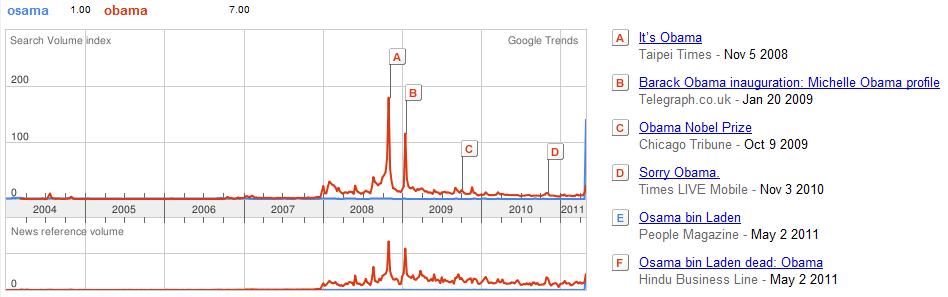
This application is similar to Google Trends, a service that shows trending topics by graphing a search term's popularity over a period of time, as a proportion of all searches. For example, here's a Google Trend graph of "osama bin laden", over the last 30 days. 


If interested, below is a close up on Obama and Harper, who were clearly overshadowed by the news of bin Laden's death. 


Google Trends allows you to go as far back as 2004, when Google was about half its current age. Here you can see obama vs. osama again, where Obama's peak on election day '08 marked his most popular day in terms of Google search.


On the other hand, Google's nGram Viewer brings "trend searching" to a time before the Internet. Since Google has digitized many books and documents from the last two centuries on Google Books and other related projects, the database can be used to create similar graphs over a much longer time period. The nGram viewer is one of several "Google Labs", a collection several side-line projects, or experiments, that are usually created out of sheer interest.

Here's a Google nGram for written references to "tiger" and "lizard", from 1800 to 2000. Interestingly, tigers are nearly twice as popular as lizards in the early 19th century, but the two converge and follow a similar path for much of the 20th century. Note that both graphs show similar ups and downs.


Lastly, here's a Google nGram I used for a presentation on Darwinism and scientific racialism. You can see the term "The Origin of Species" surge after Darwin's famous publication in 1859, reaching its peak in 1900 with several references in German nationalism texts. The term "racialism" was first introduced during this peak. You can also see a surge in the terms of "superior race" and "racialism" during the Second World war. 


[I didn't include the term "racism" because its use in literature didn't really take off until the 1960's, while the bulk of my presentation focussed on the decades between the Origin of Species and WWII. Furthermore, books on racism jumped after the 70's, and would easily normalize the other three terms to flat lines, but here's a link if you want to see it.]

I'd definitely suggest trying Books nGram Viewer if you want to show correlations and trends between two or more terms for research purposes, or just if you're bored and like looking at graphs. Have fun!

Thursday, May 5, 2011

Webtip #1: Wordle Word Clouds

Here's a new type of post, "webtips", featuring interesting web apps and tech tricks, as this site continues its identity crisis [food blog? political commentary? travel journal?]. No doubt many of them will be Google related, but let's start with one that isn't:

Name: Wordle - Beautiful Word Clouds
Platform: Internet browser
URL: www.wordle.net
Where/how I came across it: Among the great stuff shared in the artsci forum. 
What it does: It takes text, either copy/pasted or from a site's url/feed, and generates a word cloud of the most used words, with plenty of customization options.

This link is apparently nothing new, since it was first shared on the forum in late 2008, but I discovered it about two months ago. It was soon bookmarked, and I finally used it in a recent post, wrapping up a series of notes on the 2011 Canadian Federal Election. The tool itself is very, very easy to use: simply input your text, or paste a site's url, and press Go/submit.

The site uses Java to generate its word clouds, and then you will be able to customize the font, colour, and layout of the words, while removing common words as desired. You can also randomize the settings - and the nice thing is that most of them turn out pretty well.

Try it out, it's lots of fun. Below is a word cloud of this very post: