This blog is dead.

The blog is moving. I no longer intend on posting here or updating this site, but you're welcome to join me at yanatails.blogspot.ca.

hi
Showing posts with label lizard tales. Show all posts

Saturday, October 1, 2011

Lawsuit Up

"July 1st: Ideas I've Outgrown"
No one goes through life without revising some of their opinions. Take some time to reflect on some of the beliefs you’ve had to revise in your lifetime, and the importance those beliefs held for you at the time.
Topics from, A Bookful Blockhead.


Well, I bring my Canada Day post to you on this early October day, out of order and weeks late. I previously stated I had trouble with this topic - partially because I don't have a full record of my beliefs when I was much younger, and I consider most of my ideas today to have evolved gradually over the last couple years, i.e. no sudden changes that would be of much interest to you.

One revelation that I had earlier intended to be the focus of this essay was the gaps in our education system. Partially inspired by a fellow challenge blog's post on education reform, I watched "Waiting for Superman" (and could lend it to anyone who wants to see it), and have thought about the pitfalls and potholes in our system. Aside from the waves of students slipping through the cracks of our schools, the highway overall is in drastic need of repair, to the extent that demolishing even our basic foundations and rebuilding may be the best option. A shorter info-video on education reform by RSA animations can be found here. 

While I'm very interested in the ideas of education reform, my opinions are preliminary, and I will save them for a later time. But the education system falls in a category of "things that seemed wonderful when I was young, but no longer seem so good". I was blessed with decent schools and hardworking teachers, and it was easy to admire (homework aside) the public education system, but I have also come to understand the gripping reality of alarmingly high drop out rates, and the many students who were unable to grasp fundamental concepts in math, science, and English. 

I'll move on to another formal part of our society that used to "seem wonderful", well, as wonderful as patents can seem. Like public education, intellectual property is a government effort to develop a national standard and serve its citizens in their best interests. Inventors and entrepreneurs are rewarded for their aspiring ideas, and maintain a "right" over their creation. This system a) encourages people to innovate, and b) discourages direct mimicking and encourages differentiation for increased competition. More competition and more inventions lead not only to better technology for the public, but lower prices too.

Patents are supposed to be this achievement that inventors strive for - you come up with a great idea, fool around with prototypes, get your patent, and make millions/change the industry. Today's patent system is far from this ideal, filled with patent trolls, abuse, and lawsuits/counter-suits that defeat the purpose of the entire system. Throw in a modern market that emerged after the development of IP laws, say the software industry, and you see how broken and outdated patent law has become.

What is... patent abuse? Or TORONTO??????
Patent trolls are companies that develop or buy patents (often from companies going bankrupt) and never use them, generating revenue by waiting for other businesses to infringe on their patents and then suing. For example, Toronto's very own i4i received a patent in 1993 for incorporating xml into word processors. The relatively generic concept sat rather undisturbed until a few years ago, when i4i sued Microsoft for the use of xml in Microsoft Word and ultimately won a $300 million reward. These companies, and the countless other patent trolls, don't help the industry because they don't provide the services/goods to the consumers - instead, they charge those who are actually trying to innovate, or force them to find potentially more expensive workarounds.

Then you have companies that horde up patents over the years and use this power to crush any opposition. There's perhaps some anti-trust issues, and quickly these businesses become abusive. I'll let this quote from an IBM lawyer speak for itself:
"OK, maybe you don't infringe these seven patents. But we have 10,000 U.S. patents. Do you really want us to go back to Armonk [IBM headquarters in New York] and find seven patents you do infringe? Or do you want to make this easy and just pay us $20 million?" - IBM lawyers to Sun Microsystems, in the latter company's early years. Sun paid it off. 
Microsoft has currently used this technique to force Android hardware makers to pay a licensing fee, even though Microsoft hasn't contributed to this open source, free software. The company's currently making $5-$15 dollars from Samsung and HTC for every Android phone sold (totalling tens of millions per month) and is currently in a lawsuit with Motorola. In fact, Microsoft is making significantly more money by suing companies using Android freeware than by selling its own Windows Phone 7 software.

Lastly, with today's mobile industry, we've departed from a world where competitors aim to build the best products and entered an industry marked with lawsuits.
Image from Design Language News,
featured in this article on The Guardian.

Just a list of some of the ridiculous/frivolous tech lawsuits in the last few years:

  • Apple sued Samsung for "a black rectangular device with all four corners equally rounded" and for the "use of a tray that cradles products to make them immediately visible upon opening the box." Lawsuit in progress.
  • Samsung sued Apple for the ability to use internet while making a call. 
  • Apple sued Amazon for the use of the term "appstore". Apple lost. 
  • Samsung is rumoured to be suing Apple to ban the sale of the iPhone 5 in South Korea, before the phone is even released. Probably as revenge with the Galaxy Phones/Tab being blocked in Europe because of Apple lawsuits.
  • And perhaps a future frivolous lawsuit: Google has patented its doodle, as a "method of enticing users to a web site."
Yes, I did just turn a "ideas I've outgrown" essay into a full-scale rant on our patent system. But I think this is just one example of how my worldview has changed since I was ten. There are a lot of problems in the world that aren't apparent when you're younger - a teacher who smiles a lot seems like a good-enough indication of a successful school board. But now, cracks in the system have begun to appear, and I expect to see and learn more as I fly through my twenties. It's a bit saddening at times, but a world in need of repair is arguably each generation's greatest motivation to continue striving to make the world a better place. Let's get to work.

Saturday, September 3, 2011

Ribosomes

"August 5th: Theory vs Practice"
There’s the hypothesis and the experiment; the proof and the calculation; the blueprint and the end result. Do you work better with theories or their applications? What do you think modern education stresses more? Do you think these methods could be improved?
Topics from, A Bookful Blockhead.


The terms 'theory' and 'practice' bring me back to a time of piano lessons and examinations. Each Royal Conservatory level above six required both a practical performance test and a written music theory exam. I had a strong tendency (there was one exception) of achieving higher scores on the theory portion, though this observation is misleading since it's much harder to get a very high mark on a performance test. Even if I was able to factor in my percentile in each respective test, I don't think I would be able to compare my ability to comprehend theories and apply them in practice, and here's why.

I see theory and practice as two separate entities, connected much like genes and their respective proteins. DNA is the cell's way of storing information, and these codes are cut, transcribed, edited, translated, and edited some more before the cell apples its genetic code as enzymes - the machines that run the cell. A theory implies its applications, but practices don't necessarily imply their theories - i.e. you can build a protein if you know its genetic code, but you can't decode a DNA sequence given a protein, even if you're given its amino acid sequence.

A cell cannot function with DNA alone, but most functions can proceed with the presence of proteins. It doesn't matter how the cell obtained the protein - whether it was synthesized, absorbed, or provided artificially - a given protein will perform its function even if the cell doesn't have the gene. Same goes for theory and practice: I can play piano if I learn musical techniques without learning any music theory, but I can't play if I only know music theory. Theory must be applied before it can produce results, as DNA is only useful if it can be transcribed and translated as protein.

Physics tells us how sounds are produced, and how our ears respond to these vibrations. Analysis of waves and their frequencies suggest which combinations of tones are pleasant to hear. Musical theory interprets physics as notes and scales, forming guidelines for writing music of a certain style and creating masterpieces of art (and arguably mathematics) with beautiful harmonies and counterpoint. If you've studied all this theory, great - you can apply it in your songwriting, but great music has been created for millennia without this knowledge. Regardless of your understanding of theory, your work will be measured by your ability to apply your skills.

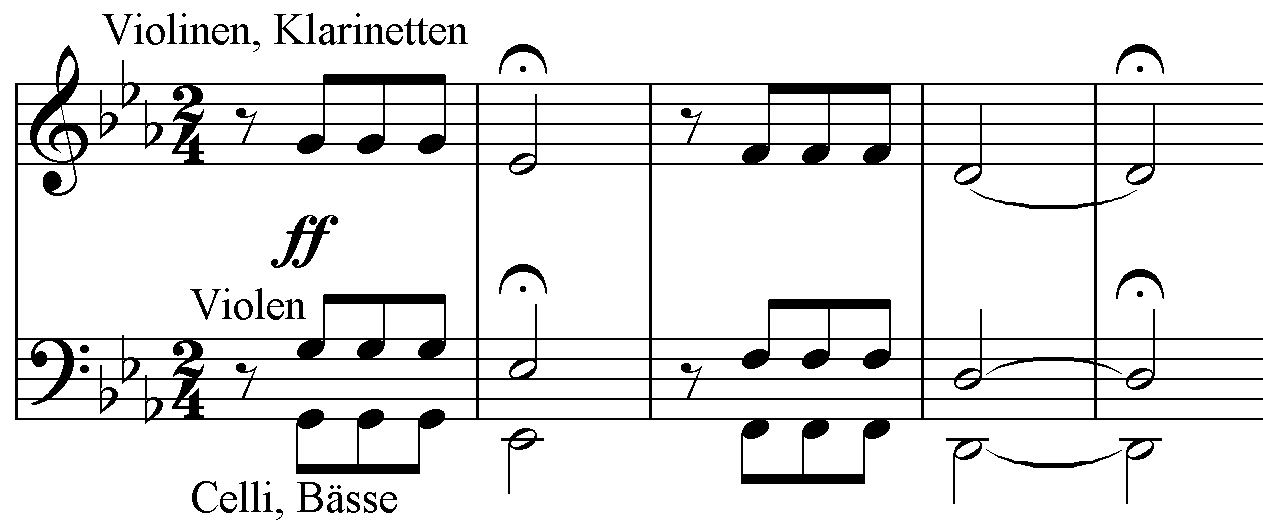
Speaking of mathematical art masterpieces, here's Bach's Crab Canon.

Or, simply put, you can't quantify your ability to work with theory - that is an application, or practise, in itself. A theory test is really just a method of quantifying one's ability to put recall thoughts and apply them as you answer questions. One can have a great understanding of music and still bomb a written test. But while I can't really state whether I (or anyone) works better with theory or applications, I can write about their significance in our education system.

When it comes down to marks, school is a test of a student's ability to apply. English students must be able to put their thoughts into essay-form, math students solve problems, biochemists conduct experiments and write reports, and musicians practice and perform. Without a doubt, there is a strong stress on applying one's skills to the task at hand.

Compared to "the real world", however, education is by far the main source of theory. Kinematic equations, the structure of a Shakespearean play, and game theory are rarely used at work, but are commonplace at a high school. Students are told to read tomes of textbooks and learn about the histories of thought that led to today's current model of the atom and the development of the English Language. School is a place for theory, though only the application of this knowledge is measured.

A Translation Party, or Translation Fiesta?
While both theory and practice are important to today's students, the most important element to take away from education isn't the DNA or their related protein products - it's the ribosomes. I feel that teachers today place an added emphasis on the ability to apply theories into applications, instead of just working with each individually. It's easy just to hand out tests, and even easier to recite the textbooks, but the best teachers are those that coach you between the two steps.

I've gone on long enough and won't detail how education can be improved, but I know that the process of application is an important component, if not the most vital part, of learning. With the internet, finding a good explanation of theory is clicks away, from a length Wikipedia article to a 10 minute lecture from the Khan Academy. When it comes to real world application skills, say the proper incision technique or figuring out that piece of office software, people will pick it up at the workplace/training in days - you don't need 12+ years to teach that to students.

Education solely based on rote memorization is bound to leave students that fail to leave a mark in the world, while those who only learn techniques will fail when the world changes around them. With all this time spent at school (by the time most people finish a Bachelor's Degree, they are more than 25% through their life), educators should stress the process of turning theory into practice. With the ribosome's components in place, you'll be able to translate any protein from any strand of DNA, no matter how foreign.

Give a man a fish, and he'll eat for a day.
Teach a man to fish, and he'll eat for years,
until there are no more fish.
Show a man how to develop hunting tools,
and he'll feed a civilization.

Thursday, August 11, 2011

August Update

With an end to an 18-day post drought, I apologize to any following readers for the not-so-awkward silence. I have been rather busy for the last couple weeks, mainly focussing on wrapping up my research at the summer lab and presenting my research, saying goodbye to my friends and family that I've had the pleasure of meeting in the last two months, watching Falling Skies, doing practice MCAT tests, and planning (and enjoying) a brief road trip as my family heads Northbound back to Toronto with stops in Atlantic City, New York, and Rochester. Oh, and I've been keeping up with news on Taiwan born pitcher, a former Yankees ace, Chien Ming Wang, who picked up his first major league win Tuesday, on his third start after two long years of rehab!

That said, I'm currently staying in Little Taipei, New York City (aka Flushing, Brooklyn) until tomorrow night before arriving back in Toronto for a final stretch MCAT study period. I'll see what posts I can get done, but I offer few guarantees until the last week of August. I still intend to finish every essay though - you have my word. Hope everyone's enjoying their summer!

p.s. had legit Bubble Tea yesterday. I've never felt so close to Taiwan outside of Taiwan until now.

Around the World in 80 Species

"July 29th: Kids stuff that's still awesome"
There are plenty of things made for kids that adults still love. Whether it’s a favourite cartoon, game or book, take a trip down memory lane and tell us why this stuff is still awesome.
Topics from, A Bookful Blockhead.

Those who have friended me on Facebook or have added me to their Circles on Google+ have probably met Casper at some point or another. To the right, he rests on his cyclohexane chair, made from the molecular modelling set that arguably serves as Lego for chemistry students.

Casper was named after the subspecies Panthera tigris virgata, more commonly known as the Caspian tiger. Though these tigers reportedly went extinct in the 1950s, recent evidence suggests that the Caspians were nearly genetically identical to today's [critically endangered] Siberian tigers, and the subspecies status has since been removed. This slap in the face was rather harsh for Casper, much akin to how you felt on August 24, 2006 when the IAU decided to demote Pluto's planet status, assuming you were named Pluto.

I actually haven't had Casper for too long, and arguably he's not much of a trip down memory lane since I don't usually let him get too far from me. Besides, this week's topic is "kids stuff that's still awesome"; Casper belongs in the circle of "kids stuff that's beyond awesome". Instead, I'll talk about tigers in general, and other animals as well, which can all be seen at your local zoo.

I'm well aware that the zoo is not always a great place for animals. Poor living conditions, small artificial habitats, and unsuitable outdoor climates are challenges that all zoos face, assuming the animals can put through with the shock of people culture and escape the death of sheer boredom. Even in the best zoos, animals still need to face the monster that is the zoo visitor, specifically the one that won't stop tapping on the glass. Nevertheless, there are pluses for the animals as well - artificial breeding is usually a last resort to the dwindling few members of an endangered species - and zoos can even be a refuge for animals who have lived in even worse conditions or have been orphaned and would not be able to survive on their own.

I'm not sure if the pros outweigh the cons, but let's pass over the issue for the time being, because either way, I still find zoos a wonderful place to be, especially if you're a kid. There is little doubt that today's zoos are made for children. Working in the Toronto Zoo for a summer kids (and consequently their parents) are the zoo's major clients - exhibits, displays, and shows are all geared towards younger audiences. A brief glimpse around the zoo and you'll see mobs of children from camps of all sorts, and rows of tiny kids sitting on those pricey Zoomobiles.

[*in, not at, since I was technically with food services and dealing with the two most annoying creatures at the zoo: seagulls and little children who insist on feeding and attracting seagulls.]

For a kid, the zoo is an amazing place. Speaking for the Toronto Zoo, it's the closest you can get to travelling the world without leaving your hometown. Animals are often geographically gathered so that you can jump from continent to continent, and who doesn't enjoy watching animals? Especially since animals make up a significant part of elementary school education, forming the basics of vocabulary in earlier years and the pillars of biology in upper years, a trip to the zoo offers great exposure to the outside world. And it's lots of fun.

But zoos are still awesome for those past their monkey-see monkey-do prime. Despite the steep entry fees for the Toronto Zoo, it's still a great escape from the city at a relatively cheap cost. Plus, despite the many displays targeted towards children, there is always something new to discover at the zoo for people of all ages - a cool species you've never heard of, a new type of beautiful fish, or a new fact about an animal you've always been curious about.

I also find the zoo to be an inspirational place - not so much due to the sounds of the birds and the monkeys or the not-so-subtle smells of manure - but as a place to see the beauty of the animals around us. Diversity is a wonderful thing, and it can even be humbling as you notice that each species, if not subspecies, has its own story to tell. I always find myself asking lots of questions - why is that animal coloured that way, how are these two animals communicating with each other, what is this animal thinking right now with all these people observing?

I still thoroughly enjoy the zoo, very much. Even in my university years, I visit frequently enough, seeing the Taipei Zoo last summer, passing by the Central Park Zoo in June, and exploring the Washington National Zoo just days ago. I don't think I'll tire of them anytime soon, and I believe that seeing all these other animals from all over the world is a rather uniquely human experience - for people of all ages.

Saturday, July 23, 2011

Beethoven Returns

"July 22nd: Words to live up to"
There are words to live by – quotations which we try to embody in day to day life. Then there are words to live up to – the principles which we try to uphold, but which we often fall short of. Pick one of those quotations which you aspire towards. Why do you feel you fall short of its aim? Why is it worth living up to?
Topics from, A Bookful Blockhead.

You could read my post below, or you could just read the quote, take it in, and move on with your life. That's really just the highlight of this all.

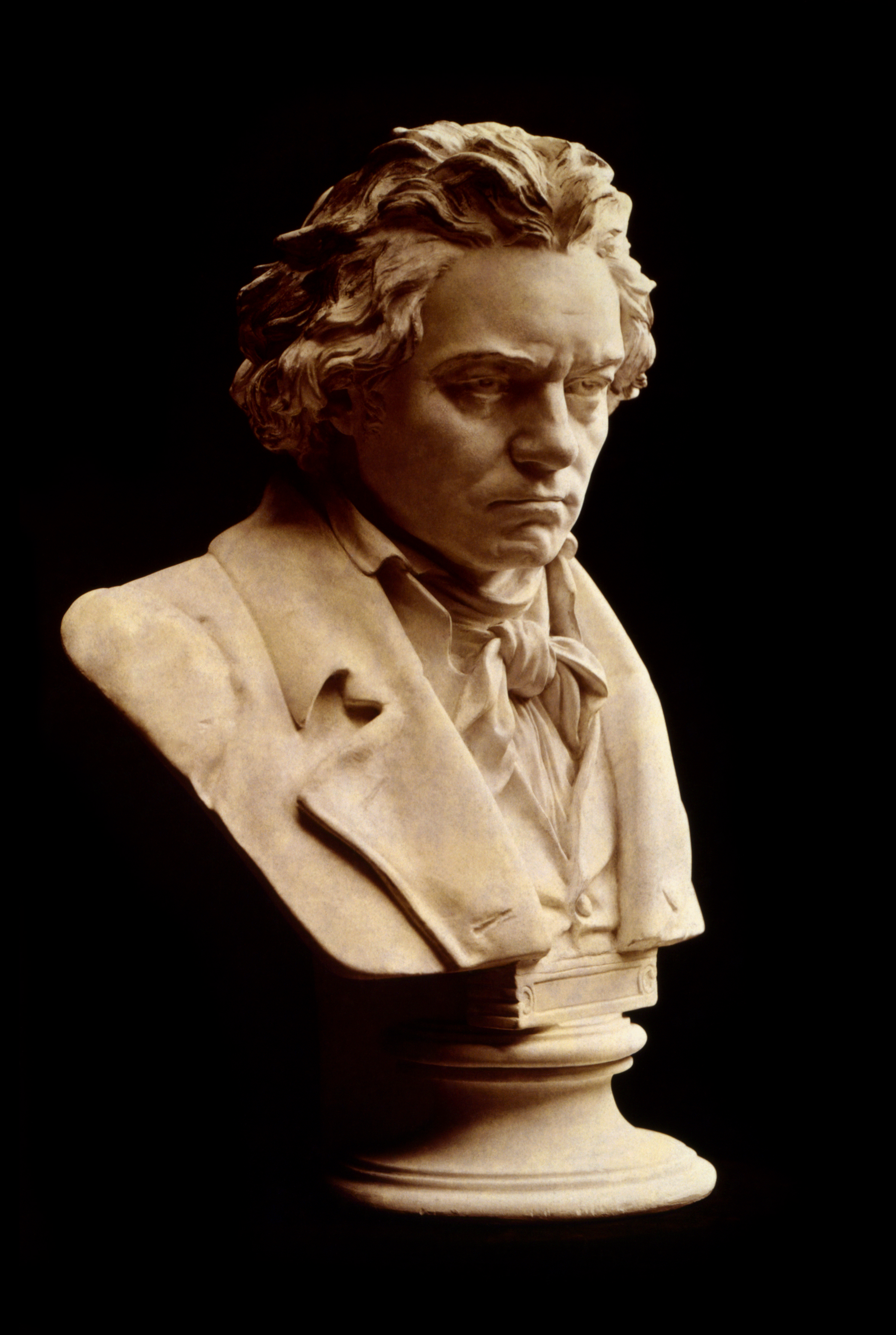
Beethoven on my blog is like the four note motif in his Fifth Symphony - he just keeps coming back. A quick search of my blog (Google to the left! i.e. sidebar, top) shows ten posts mentioning him (though now it'll be eleven), including four (now five) of the essay-a-week essays. I will post a word cloud when I get to the end of the summer...

There is much in the composer to aspire towards, but I really don't see the need for a second extensive post detailing how awesome Beethoven is. Great compositions aside, below is a quote by Beethoven that defines the principles I try to uphold:
"Then let us all do what is right,
strive with all our might toward the unattainable,
develop as fully as we can the gifts God has given us,
and never stop learning."
Why are these words worth living up to? Well, seeing that the quote is essentially combining a lot of commonly agreed on ideals, it's hard to say that these words are not worth living up to. Declaring that we should all "do what is wrong, ignore what is unattainable, repress as fully as we can the gifts God has given us, and stop learning" wouldn't be a very positive notion. Simply put, these words tell us to always do our best, and to become the best that we can be. It's a big task, so Beethoven gives us four key tips for getting there.

First, we must do what is right. In my opinion, things that are right are things that improve our lives and the lives of others. If we stay on track with good intentions, people will build closer and stronger communities, and we will be happier overall. Of course, the phrase is easier said than done - doing the "right" thing is often cloudy and our imperfect judgement makes it difficult to choose the better deed, while bad deeds are often tempting. Nevertheless, I try to live up to this phrase by doing things with good intentions, a judgement that improves as I learn from my mistakes. After all, we're reminded at the end of the quote to never stop learning, and as time goes on, it will be easier to know what is right. To do the right thing, however, takes another leap.

With good intentions, the next step is to "strive with all our might towards the unattainable". Throughout Beethoven's repertoire, he explores new instruments and arrangements; each successive piece seems to command greater emotion and energy. His final frontier was music, and he pushed through with his ninth and final symphony. The same applies to us: we each have interests that we are pursuing, and in order to collectively move our respective fields forward, we owe it to our studies to do as much as we can. I don't think I've done very well with this in the last few years - it's so easy to take comfort in the status quo. It takes a lot of effort to set your goals just beyond your reach so that you're always reaching, but in order to truly make a difference in a world (which seems unattainable as well), one must actually set the goal of doing so. [In other words, acceptable is nowhere near good enough - one needs to be exceeding expectations, if not outstanding.]

The next piece of the puzzle tells us to use our natural talents. Everyone has something unique to contribute to a group - there are few things more saddening than seeing great talent go to waste. Plus, if you're doing something that you're naturally skilled at, you feel less stressed and can find a job that makes more out of what you enjoy - everyone benefits. It's just good economics.

Lastly, never stop learning. The world is a fascinating place - I think it's actually much more difficult to stop learning, so why work against it? Just go with the flow and be receptive to new ideas and pick up new skills on a daily basis. I actually find this one the easiest of them all, and it will help you to recognize what is right, find more ways to achieve your dreams, and further develop your God-given gifts.

Arguably, this quote may be too ideal and unattainable on its own front (meta!), but that's what makes these words so worthy of great aspiration (and inspiration). Trying to reach these words by Beethoven is the story of my life. And his ninth symphony is the soundtrack.

Impatiently late

"July 15th: Vices I admire"
Sometimes you’ve got to be bad to be good. Give a defence for one character trait which you think gets a bad rap.
Topics from, A Bookful Blockhead.

To those on the same boat, you're probably aware of what the following is all about. 30 minutes each, spell check disabled, etc. Hopefully the added pressure of each of these going online will somewhat simulate test day anxiety? And now for hitting two birds with one stone - getting some writing practice and catching up on some essays.

For each prompt, write a unified essay in which you perform the following tasks: Explain what you think the statement means. Describe a specific situation that illustrates a point of view directly opposite of the one expressed in the statement. Explain how the conflict in between the viewpoint in the statement and the viewpoint in the second task might be resolved.


Prompt: Sometimes you've got to be bad to be good. 

Deciding that good actions are justifiable and bad actions are not, is often a quickly made judgement. Many politicians campaign on a "do good" strategy, and no one wants to be painted as someone who makes bad decisions. But when dealing with many problems, small or big, one often realizes that making the right choice is often a difficult decision, as getting things done often require being involved dealing with bad people, or making potentially harmful choices. As a result, when bad choices are required in order to achieve good results, these bad choices can also be justifiable.

The common example of needing to be bad involves dealing with an enemy. On the scale of nations, this problem usually involves military or intelligence operations, if not war. War is arguably a bad action - even when fought under the name of justice, war involves murder, the destruction of homes and cities, and invoking fear on other people, including those who are innocent. A country facing a violent enemy, especially when peaceful settlements fail, often has a choice of not fighting, or waging a war. Not fighting could lead to devasting results, making war a viable solution. In order to eliminate or reduce the threat of the enemy, an act of good, countries may have to engage in war, a bad action. Making this choice is often referred to "the lesser of two evils".

[I realized at this point that most prompts tend to use "always"..., as it's weird to argue for the opposite of "sometimes" (would it be "mosttimes"?). I tried nevertheless, and tried to describe an example for "never".]

On the other hand, it is difficult to gauge whether or not the bad deed will ultimately lead to good. For example, the War in Afghanistan, often depicted by western governments as a necessary evil in order to democratize the Middle East and remove terrorist threats. Choosing to wage a war in the area has not been able to remove the influence of the Taliban and has led to the formation of a corruption-filled government, while all sides have been left with several casualities and wasted efforts. Because people cannot predict the future, it can be argued that the safest position to adopt would be to avoid any bad deeds. Instead of trying to solve corruption by being involved with corruptive powers, the best plan may simply be to only do good - eventually, the bad forces will lose their fuel as governments refuse to deal with them. This step is arguably "the greater of two evils", where the country chooses not to engage in war and suffer the consequences, but as  doing evil to escape evil may not necessary work, choosing doing the good thing may lead to the best results without risking any evil in the first place.

Because it is difficult to predict the consequences or rewards of a good or bad action, doing the good action all the time may be safest, avoiding the worst case scenario of doing a bad action that leads to worse results. However, a bad deed is often disguised as a good deed, under the "lesser of two evils" approach. As it is difficult to distinguish a good and a bad action, it's often best to follow the "best" approach, where if the bad deed disguised as a good deed is a better option than even all good deeds, that bad action is justifiable. Thus, sometimes, you've got to be bad to be good, but it must be clear at all times that your ultimate goal is to be good.


Prompt: Impatience is a vice that gets a bad rap, but is a vice that is admirable.

Patience is one of the seven virtues, and is a trait that most people try to display in order to live a morally good life. Consequently, impatience is a vice and is often frowned on by others. Young children are taught to be patient, told to be quiet and wait their turn, and scolded when they ask "are we there yet?" on long road trips. Adults must wait a lot too - for medical scans, returned calls, and at long lines at the supermarket. Being impatient gets a bad rap, no one likes to see a frustrated person tapping their foot and checking their watch constantly, but being impatience can also admirable.

Impatience can result from a bad system, such as an overloaded or underfunded medical system or a bureaucratic government. In these cases, impatience is often the fuel needed to push for reform and making changes to alleviate the long wait times, leading to long term success. One example is the bureaucratic system controlling public education in Washington D.C. Michelle Rhee, appointed in 2007 to lead the city's education department, is a teacher and parent, who was frustrated with the cities public education. Her impatience with the system led to the choice to send her own kids to private school, feeling that the public education system was so poor that the only way to assure her children a good education would be to send them outside the system. Secondly, in her power, she controversially fired hundreds of teachers and principals to remove underqualified individuals. While her predecessors patiently discussed several measures with Unions, government department, and schools, Michelle Rhee took tough measures to get reform accomplished as soon as possible. This impatience that led to reform to improve both public education and her own children's education is admirable. 

However, as a vice, impatience can lead to poor results. Under Rhee's term, reports of teachers adjusting the test scores have significantly increased, indicating that there have been other consequences to the impatience of getting measures passed quickly and demanding immediate improvements. In other examples, impatience in construction often lead to flaws and cutbacks. Impatience may get things done faster, but being impatience places the need for speed as the top priority. When one is impatient, they often put safety and other concerns second. A driver late for work is much more likely to run a yellow light and make tight turns that may lead to more accidents. Thus, impatience on its own is not admirable, only its results, when things turn right, seem to be worthy of praise. 

Impatience can be a fuel to get things done faster, a source of motivation. There are benefits to being impatient, but if impatience is the main reason to get things done, there are risks of cutting corners and losing motivation if one is forced to wait. Impatience, though it gets a bad rap, can be a force for good and admirable things, but its role in making those things happen must be evaluated. Impatience must never be a priority, but keeping it mind might lead to virtious results. 

Saturday, July 9, 2011

In confidence alone

"July 8th: Virtues I abhor"
Face it. The “upright citizen” can be a real prick sometimes. Pick that one character trait which you think is totally overrated, and tear a strip off of it.
Topics from, A Bookful Blockhead.

I believe that any virtue, or any vice, is good with moderation. Even the "best" virtues can steer one in the wrong direction if over-practised, and there are situations for vices to be appropriate (i.e. A Time for Everything). While it's easy to deride an overdone virtue, which is often what defines said "prick", picking a character trait that is overrated, even in moderation, is a rather challenging task.

I first looked at the seven heavenly virtues and realized I could not honestly write this essay because I don't find any of them to be overrated. Patience and diligence probably being my favourite two, it's also hard to appreciate those who are humble, kind, generous, and tempered. I suppose chastity can be argued as being overrated or irrelevant to much of today's youth, but I see the term as an embodiment of honesty - to oneself and to others - as well as following a healthy lifestyle.

Broadening my search terms for virtues, I found a long list of them and came across confidence. I'm not sure why it stood out - perhaps because Julie Andrews voice has not left my mind since the Mary Poppins post - but I had found my victim. I'm not sure if I've always considered confidence to be a virtue (Wikipedia seems to), but a virtue is defined as a quality or trait perceived as morally good and I would agree that having confidence (thus belief in one's own abilities) is a part of building a strong moral character. I will note that I'm using "confidence" synonymously with "self-confidence"; confidence in others is often referred to as "trust".

Don't get me wrong, confidence is a good thing (and I definitely don't abhor it). It is a trait that's practically a must in the workplace and in leadership. It is a quality we seek in others, and a quality we constantly try to build in ourselves. Confidence is also a dangerous virtue: too much of it can lead to over-confidence, or even arrogance. Confidence is a virtue that must be closely monitored.

In moderation, confidence has become a virtue that everyone expects of you. An impatient person can be seen as a politician who gets things done, a lack of generosity can be seen as a plus in the business world, and humility can often lead to being overlooked in a room of outspoken people. But no confidence? You probably aren't going anywhere.

Confidence is overrated because it is not necessarily reflective of one's actual skills, and society forces people to appear confident even when they are not. Often the confident person will be hired over a less confident person, even if the second person is more qualified. Because of the weight that society places on confidence, the employer may have to use more resources to train the more confident individual, while the second individual's skills go to waste. A rather inefficient system if you ask me.

The latter can be dangerous - pretending to be confident often distorts one's real personality which will emerge in due time anyways. The false confidence not only brings a level of uncertainty and worry to the individual, others may also make assumptions or assign tasks that the individual may be incapable of doing. Yet, putting on an air of confidence is relatively common, if not expected, for job interviews, first dates, and at school. False confidence is not an example of a virtue, nor is it over-confidence, but it is a quality that exists because confidence is so positively viewed, or overrated.

Ultimately, confidence is a good thing, if not great - it can greatly enhance one's ability to perform and it helps to build trust in a community. But as an overrated quality, confidence easily shadows other virtues and can direct focus away from other important traits. Perhaps most of all, everyone has a different level of confidence.  In order to build confidence in everyone while avoiding arrogance or false confidence, people must be patient and diligent and give everyone a chance to shine and build their other skills.

As I see it, confidence is a virtue that comes with the others, but viewing it above the others as it is currently overrated, will only lead to more problems.

Number 9

"July 1st: Ideas I've Outgrown"
No one goes through life without revising some of their opinions. Take some time to reflect on some of the beliefs you’ve had to revise in your lifetime, and the importance those beliefs held for you at the time.
Topics from, A Bookful Blockhead.

Nine weeks ago, I had the opinion that the best way to take on this challenge was one week at a time, finishing each topic in order. But then I came across this challenging topic (for me, the hardest out of the 16... I think) and have stalled for a week, though I did give myself a break for an awesome (repeat: awesome) weekend at the Taiwanese American Next Generation conference.

I've thought about the topic for about two weeks now, and while I have had some ideas (for ideas), none of them have taken off. So I'm going to revise my earlier goal to finish the challenge as is, adopt a "better late than never" position, and hope to have Week 9's essay out before the challenge comes to a close. Perhaps tomorrow, perhaps in nine days, or maybe right before school starts. We'll see.

Meanwhile, Essay 10 should be out by tomorrow - I promise!

Friday, June 24, 2011

The cake is a pie.

"June 24th: Cake vs Pie (Alternatively, for the gluten free: Sorbet vs Ice Cream)"
The great debate. What is the chosen dessert?
 Topics from, A Bookful Blockhead.


Of the thirty teeth I currently have, I lack a sweet tooth, and usually prefer "savoury" in the sweet vs. savoury debate. Of cake and pie, I have a better impression of cake, as it seems to be ever present at the most important moments of our lives: birthdays, graduations, and weddings. Pies are also relatively rare in Asian cuisine (to my knowledge). Growing up, I would rarely have the opportunity to eat pies, with the exception of egg tarts (which are technically pies?).

But if this argument is supposed to be for "the great debate", I lack the authority or experience to make convincing statements and even my anecdotal evidence is weak. So instead, I turn to my peers - no, not fellow essayists (n will probably be less than thirty), but all those netizens on the world wide web. And if I can assume that those who frequent the world's most visited website represent an unbiased sample in the cake vs. pie debate (I see no reason for dessert bias), then I think we should have no problems consulting Google, which now sees over a billion unique visitors on a monthly basis. Thus, here begins five rounds of dessert-filled searching:

Round 1: Google Search (via Google Insights for Search)
Google Insights for Search is essentially a spruced up version of Google Trends, which I talk about in the beginning of this blog post. We can start by comparing the worldwide search volumes of "cake" and "pie" since 2004. 


On average, there are 40% more searches for cake than pie, though pie enjoys a peak during late November, presumably for American Thanksgiving. Both terms are gaining search share each year, but cake takes the cake, surpassing pie queries year round since 2008. Furthermore, while the top search for pie is American Pie, an extra boost from the song and the movies, all top ten searches for cake are food related (i.e. cake recipe, chocolate cake, birthday cake, wedding cake, cheese cake). Round one clearly goes to cake.
Google Doodle: Google's 4th Birthday, celebrating with cake.

Round 2: 
Youtube
Despite cake's popularity among websites, pie is the bigger star of Youtube filmography. A simple search shows 748 000 hits for pies and 667 000 results for cake. While covers of American Pie take some of the fill, pies show their versatility with video recipes, animations, and the pieing of politicians like former Prime Minister Jean Chretien. Cake, on the other hand, is out-layered with songs by Cake, a band. The first dessert-based video is far down the page, trumped by more than ten other music or comedy videos.

In true Youtube fashion, cake appears to be most viral, with "chubby cubby cake boy" at the top with 52 million views. Meanwhile, Youtube ranks "LA CINTURA MAS DELGADA DEL MUNDA" (translation: world's thinnest waist) as the most watched video among the results for "pie", seemingly at a big sacrifice to relevance. The video has 47 million views, greater than the population of Spain, but does not seem to mention pie at all.


With the two desserts  each with an advantage in either general popularity or viral trending, pie takes the lead with the President Obama's Youtube endorsement near the top of its results with "I like pie. You like pie too?" So congratulations oh crusty dessert, you've just won Round Two.  
Thanksgiving, 2005. Bush may have pardoned the turkey, but that pie's not going anywhere.

Round 3: Google Images
This round was an easy one for cake, topping pie with 56.1 million hits compared to 31.7 million. And it wasn't just sheer numbers that made this an easy win for cake:


Cake pictures have a lot more design and pattern - the dessert is like a blank canvas for the artist, or cook, to prepare - that's why you have shows like Ace of Cakes, and that's why the cake is one of the centrepieces of a wedding banquet. There is so much variation and creativity that can go into a cake, a media which pie can't seem to rival (clip art?!?). Perhaps it's the pie filling that gives it some inner beauty, but in terms of photo shoots, cake is getting the cover page and the centrefold.
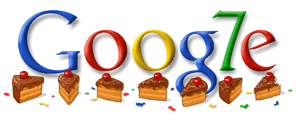
Google's 7th Birthday.


Round 4: Google Scholar, Patents
I decided to take a more scientific approach to the debate, and looked up scholarly articles on cake and pie. The first thing I learned was that Pie is the more popular last name - most of the top results featured the dessert surnames, and pie led with 1.8 million results, doubling cake's hits. Filtering the search terms to the article titles, pie maintained its lead by a small margin. Here are some of the more intriguing titles:

This is some serious stuff[ing].

A "Pie-Juice Saver".
I also did a patent search that confirmed pie's victory. Despite cake's creative side, inventors seem to be more inclined to develop creative new ideas for the pie. Interesting patents included: a pie-juice saver, a cake umbrella, a pie ventilator, a cutting guide for layered cake, an eskimo pie vending machine, a device for preventing a cake from slipping on a plate, and also - a "combined cake and pie". Despite the efforts for peace, the debate rages on...
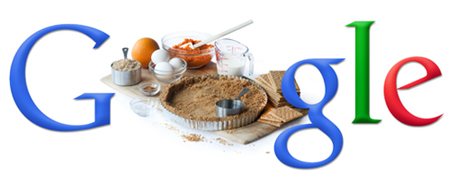
Thanksgiving, 2010. Another interesting fact, Google recently got the patent for its Doodles.


Round 5: Google Books (via Google Ngram Viewer)
Lastly, I shall add some historical perspective to the debate, and compare the appearances of the two desserts in the past 200 years (1800-2000). The Google Ngram Viewer (blog post here) takes advantage of Google's digitization of Books, and plots the use of terms or phrases over time. 


While we can only speculate on the popularity of desserts during both World Wars, cake is by far the more popular of the two. The only time pie was mentioned more often was before 1835, with the dessert also riding the wave of the Latin word "pie", stemming from the word "pius", seen in famous texts and poems with the phrase "pie Jesu". As pie seems to be even less popular at the start of the 21st century than the 19th century, while cake has doubled its relative share, the winner of the round 5 shall be cake!
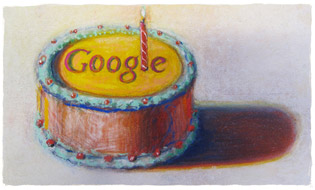
Google's 12th Birthday, drawn by Wayne Thiebaud.

A Cake-Pie Chart!
So cake wins the Google challenge! If you have any disputes or questions, feel free to comment below. Google, of course, offers many other search features that you can also test, though a quick run through of them will show that cake has more results, most of the time. 

Final note: The top Google result for "cake vs. pie" brings you to one of the most awesome blogs out there, "Hyperbole and a Half", who lays out alot of arguments for pie. With all the "cake vs. pie" arguments among fellow essayists, I wonder if we'll start seeing our debates there too! Happy writing!

Congratulations Cake!
- from a 10 year old Google.

Wednesday, June 22, 2011

Götterfunken!

"June 17th: Music that Moves Me"
Tell us about a song, an album or a band which speaks to you in that most universal of languages.
Topics from, A Bookful Blockhead.


If, for whatever reason, there were any surprises in the previous essays of the last six weeks, I inform you there will be none of that today, as I will be writing about one of the most moving and universal pieces of music ever composed: Beethoven's Ninth Symphony (full symphony, youtube playlist). It is no secret that Beethoven is my favourite composer and one of my greatest inspirations, and I have already referenced his ninth in a previous essay. Also, important to note, it's only 177 more days until Beethoven's birthday!

I was probably introduced to the music of Beethoven very early in life, as for most people. One of Classical music's most prominent composers (technically, late Classical to early Romantic), Beethoven's music can be heard anywhere, whether it's the doom-inciting four note motif of his fifth symphony or the graceful broken piano chords of his Moonlight Sonata (referring to the first movement, of course, though I also love the third).

I had a more formal introduction to the great composer not long after I started playing piano. Using the Bastien Piano series for beginners to kickstart about twelve years worth of lessons, a simplified Ode to Joy found its way into my repertoire of music, along with arrangements of Joplin's The Entertainer, and Hadyn's Surprise Symphony, all pieces that I still love today. But it was Beethoven that would remain my favourite composer, especially when I could begin playing some of his unabridged music, starting with sonatinas, moving through variations, and finally meeting the sonatas.

I also remember listening to the audio book of "Beethoven Lives Upstairs" (on cassettes, of course!), a story of a young boy who befriends the eccentric composer. Each section of the book was accompanied with Beethoven's music, usually his famous piano compositions like Fur Elise or Minuet in G. But as Beethoven continued to compose (in his real life), his music became more commanding. His early sonatas were much shorter, with simple themes typical of the Classical composers before him. By his last few sonatas (notably, the Hammerklavier), he uses the entire length of the keyboard to create his powerful music, a test of the emotions of the early Romantic period.


Left: An Early Sonata (the first of thirty-two); Right: A Late Sonata (Hammerklavier - 29th)
Just the opening minute of each can show you Beethoven's dramatic growth in music style. 

Beethoven in Central Park, New York.
Beethoven first embraced the work of music known as the symphony in his mid-twenties, shortly before his tragic, gradual loss of hearing. Like his sonatas, his symphonies document his growth as a composer, as well as his continual struggles with deafness and culture's transition to Romanticism. His third symphony, the Eroica (Heroic), was written in praise of Napoleon and his role in the French Revolution. His fifth, perhaps his most famous symphony (but I would argue for the ninth), is also a masterpiece - I was lucky enough to perform its final movement in my last year with my high school symphony. The piece ends with twenty-nine measures of pure C-chords, essentially an epic cadence to a thundering symphony.

Beethoven became disillusioned with European politics as Napoleon was declared emperor (tearing the title page of his third symphony in rage). Later, Beethoven found hope in a more liberal society, emerging in the Romantic period, and gave a triumphant tribute to freedom in his last symphony, his ninth. The fourth and last movement featured a choir singing the famous theme to Ode to Joy, arguably the most well known four-ish minutes of his ninth symphony. But the other seventy or so minutes (length depends on recording) of Beethoven's ninth are far from preamble and background - each movement captures a different aspect of Beethoven's emotion in the final years of his life, and is a worthy work of music on its own.

Having been a part of a string orchestra in school for about seven years, I find a bit of magic to the sound of the orchestra tuning, and that's how the first movement of the ninth seems to begin (video to the right). The instruments and their melodies soon pick up speed and volume, and soon there is a full strength symphony (actually, double strength - the ninth was performed with several additional parts and players) that brings in a dark theme reminiscent of his fifth.

The second movement, played very quickly (molto vivace to be exact), is much lighter to contrast the first movement and features a timpani solo (my favourite non-keyboard percussion instrument). The fast-paced section still has the drama of the first movement in an endless battle between its three and four beat rhythms and the recurring theme in a fugue-like form.

The third movement is the symphony's slow movement, allowing tension to build for the fourth and final movement, and plenty of time to draw out its powerful themes, as the notes and rhythms become more complex as the movement approaches its end. Then the fourth movement comes in, and by the time the solo tenor sings his opening to introduce the choir, you know you're listening to a whole new world of music.

The first ten minutes of the fourth movement, also known as "symphony within a symphony". You can hear some of the previous movements coming back, starting with the first at 00:50. The theme begins creeping in at 2:55, stronger by 4:16, and in full force (orchestra-wise) by 4:59. The tenor enters the scene at 6:30, and the famous chorus has its moment at 7:44. Note: see conductor at 8:38.

And yet, Beethoven was fully deaf (though not necessarily permanently - his hearing senses fluctuated) when he composed this grand symphony. He insisted on conducting (his first public performance in over decade after a disastrous piano concerto) and shared the stage with Michael Umlauf, the theatre's choirmaster. Beethoven conducted with all the gestures, though the musicians were informed to ignore the deaf composer and to follow Umlauf. From Wikipedia, "He was turning the pages of his score and beating time for an orchestra he could not hear."

Playing the symphony slightly slower in his mind (oh what a mind), he was still conducting when the orchestra had finished, and had to be turned around to see the standing ovation of the audience. They gave Beethoven five standing ovations, and made gestures - raised hands and thrown handkerchiefs and hats - so that Beethoven could see and feel the applause. A second concert of his ninth symphony would be his last public on-stage appearance. Beethoven passed away three years later with the beginnings of a tenth, and started the superstition known as the "curse of the ninth".

Handwritten notes from Beethoven's Ninth. 
The symphony is no doubt "music that moves me", and is also music that moves people worldwide. The theme to Ode to Joy is not only a piece of music that captures the hearts of individuals. Beethoven's music has inspired entire nations, and yet remains independent of the countries and their respective ideologies to remain a musical piece that all can love.

Beethoven's music was embraced by Hitler who admired the composer's genius; the Ninth Symphony could be heard at Nazi rallies. At the same time, Ode to Joy was also played in Britain for hope during the war as an anti-Nazi song. The ninth symphony returned as an anthem for a unified Germany and was played when the Berlin Wall was being torn down. Ode to Joy was also popular in post-cultural revolution Communist China symbolizing joy through struggling, while played yearly in Japan to celebrate the freedom in democracy. And, of lastly, the symphony's famous melody has been played worldwide at Olympic Events and has been adopted as the anthem of the European Union.

Compact Discs: Just enough
for Beethoven's Ninth. 
Beethoven's Ninth Symphony may not be the most popular song compared to modern music tastes, but it was definitely a favourite of Norio Ohga, one of the pioneers of today's CDs (though those are on their way out). Previously, a performance of Beethoven's ninth required three sides of a vinyl disc (well, one and a half); Ohga insisted that the CD should be able to play the entire symphony uninterrupted. Soon, the standard became the 12-cm disc, much to the dismay of Sony who had preferred their proprietary 11.5 cm discs that would just cut out the coda of Beethoven's Ninth (of the faster recordings).

So next time you pick up an album or a mix tape, considering listening to the full Ninth Symphony, and relive the life of Beethoven, the emotions of the Romantic period, and the histories of nations worldwide that have embraced his Ode to Joy.


p.s. for those more interested in Beethoven's symphonies, you can easily run through all of them twice when pulling an all nighter!

Friday, June 17, 2011

19.15 mmol of C6H12O6

Essay-a-Week Challenge - Week 6, Part 2
"June 10th: One Movie Everyone Should See"
Whether a chick flick or a slasher, take go ahead and gush about a film you love.
Topics from, A Bookful Blockhead.

Part 1 (preamble), here. 


Unlike the mysteriously magical nanny, the above recording is not practically perfect in every way, due to some rusty fingers and poor recording equipment. But enjoy nonetheless =). 

My favourite movie, and perhaps the movie everyone should see, is Mary Poppins. It's a movie based on a children's book, and while its appeal is mostly for kids, the story brings out the inner child in everyone. There are plenty of heart-warming themes, a cast of interesting characters, and an endless track of wonderful songs. Despite the father, Mr. Banks, playing the early antagonist, by the end you'll feel happy for everyone in the entire family as Mary Poppins floats away in the distance.

I have always enjoyed watching my favourite movies and shows over and over again, and I have watched Mary Poppins dozens of times. I never tire of the music, the penguins, and the tap-dance number of "Step-in-Time". Most recently, I went through much of the film last Wednesday, while facing the much dreaded, corrupted server-monster that hosts McMaster's course registration services (needing to get up early the next morning, I started Mary Poppins at midnight and promised myself to go to sleep if the movie finished before I got into the system, as opposed to staying up 'til 3:30 the previous year to get into just 40% of my courses). Thankfully, the movie made the "tab, enter, enter, and repeat" sequence slightly more bearable.

Mary Poppins, Julie Andrew's first major movie, was filmed in 1964 in glorious 2-D. Arguably a classic, the movie does not feel like one, with its main conflict - the battle between work and family - at the heart of modern troubles, and it is easy to relate to the Banks family. Only we wish we could have such a mysterious, magical nanny to pay us a visit.

Whenever you're a bit bored, or looking for a movie to cheer you up a bit and release your inner, confused-but-optimistic child, then consider picking up Mary Poppins. Oh, and the music. is. wonderful. Besides Chim Chim Cher-ee winning the Oscar for Best Original Song, I enjoy every song of the movie, from the famous "Supercalifragilisticexpialidocious" and "A Spoonful of Sugar", to Mrs. Bank's "Sister Suffragettes". Oh yeah, the film won Best Original Score as well.

Besides showcasing a lovely repertoire of Disney songs, I give credit to Mary Poppins for my self-training at a young age to "play by ear", that is, playing a song after listening to it. The first song I can recall trying to figure out is Chim Chim Cher-ee, and once I was able to reproduce its melody (I even scribbled down some messy notes on staff paper), I was soon trying to replicate any song I wanted to learn. More than 10 years later as I write this, I've embedded a more recent play-by-ear attempt [above], a Mary Poppins medley that I put together earlier this week, played courtesy of my aunt and uncle's newly-tuned piano.

I hope that you've all watched this movie at some point, and can reflect on some of the scenes and clips from Youtube and recall your thoughts and feelings from when you first watched it. And if you haven't watched it yet, I would strongly suggest watching Mary Poppins. Or even better [perhaps], seeing the musical adaption, Mary Poppins the Musical, in person. I was lucky enough to see in last week, and my post about that can be seen here (to be written).

Sorry for this late post, but better late than never. I'll leave you with a video clip of "Step In Time", and I hope I'll be in time for the next post.

Thursday, June 9, 2011

Well begun is half done.

Essay-a-Week Challenge - Week 6
"June 10th: One Movie Everyone Should See"
Whether a chick flick or a slasher, take go ahead and gush about a film you love.
Topics from, A Bookful Blockhead.

I will be in New York for the next couple of days, so I present to you the first half of this post. The second half is already written, at least in my mind, but I'll leave you with my usual preamble for now; I hope for a surprise early next week. But for now...

There is a bit of contradiction between this week's title and its subject, since a film that I love is not necessarily the one movie everyone should see. More importantly, I don't watch many movies (not that I don't like them - there are some that I love!). I tend to watch movies only when the occasion arises - in a class, when friends organize something, on a long flight. As a result, there's a long list of classics and blockbusters and films with critical acclaim I have not seen [that I'm sure to read about in the upcoming week]; the likelihood of the "one movie everyone should see" falling into the category of "movies I have seen" isn't very high. (hidden premise: I shouldn't label a movie as "one movie everyone should see" until I have seen it).

I consider this wave of topics, starting last week, to be part of the second theme: choices (the first theme being personal knowledge). We are tasked with choosing a favourite book, movie, film, or dessert, and then asked to defend our choice. In reading the posts of several bloggers, I found the reasoning for their favourite book to be just as interesting as the book itself. One of my favourite posts of the past week (from, "This could end badly") concluded that "the book that everyone should read" should be a children's book.

I will apply the same logic here, and say that "the book everyone should read" should be a children's movie. Possibly because I'm biased, and I grew up in the Golden Age of Disney Animation. Also probably because I watched more movies when I was a kid. But perhaps it's because the movies that convey simple themes through light-hearted plots filled with songs and music are what people really need. These movies are not only geared for the kids but for their parents too.

The movie I believe everyone should see is a musical film, based on a children's book.

... to be updated early next week!

Friday, June 3, 2011

Read! Read! Read!

Essay-a-Week Challenge - Week 5
"June 3rd: One Book Everyone Should Read"
We all have a handful of books we just can’t stop talking about. Pick one and tell the world why you love it and what you think other people will get out of it.
Topics from, A Bookful Blockhead.


Also one of my favourite beards.
If there is a book that everyone should read, that book needs to be good, and not just in the literary sense. Good books are those that can affect your life or the way you see the world, those that enhance your mind and your thoughts, and those that bring you peace, catharsis.

Plenty of titles come to mind. One of my favourite books is Fifth Business, a novel by Canadian author Robertson Davies, chosen for our Grade 12 English class. The narrative focussed on the theme of finding one's place in the world, providing new perspectives in a time of decision-making. On another note, I would credit Charles Darwin and his famous publication, On The Origin of Species, for enhancing the way I think and study as I admire Darwin's ability to experience the world around him and beautifully translate his ideas into the founding ideas of natural selection. For finding peace, I enjoy reading the picture books and novels I grew up with, I suppose connecting with a younger self of a simpler time, re-exploring the deep themes of Lois Lowry's The Giver or enjoying the simple themes of The Very Hungry Caterpillar, by Eric Carle.

mmm... Google.

For me, there is one book that satisfies all three - affecting my life, my thoughts, and giving me peace - and that book would be the Bible. The Bible can be many things: a source of stories and parables to learn from, a record of the events in the lives of Jesus, prophets, and historical figures, and passages that inspire reflect on the themes and questions that have been with humankind forever.

But for this essay, I will not choose the Bible, partially because religion and spiritually should not be forced on individuals. I do believe, however, that the Bible contains a lot of interesting and useful passages, and as the most published book and a text that is found in many religious and cultural studies, people should be exposed, at the very least, to parts of the Bible as one experiments with their own spirituality and philosophy, as they explore one of the core elements of humanity. Also, the Bible is rather long, and in a society driven by tweets, making the Bible a book everyone should read is not very realistic.

On the plus side, the Bible is very accessible - they are often given out for free, it's available online and for many different reading levels, and is the world's most translated book. Since the Bible is also a collection of many books, by various authors, written at different times, I will instead choose one of these - short, enough to be accessible and readable by everyone, and relevant, something we can all reflect on. While one of the Gospels might seem like the obvious choice, I will go with a personal favourite, the book of Ecclesiastes (link to full text).

There is debate over the author of the relatively short twelve chapters (perhaps shorter than the Wikipedia page describing the book), who describes himself as "the preacher, the son of David, king in Jerusalem" (English Standard Version). Some point to the wise King Solomon, who is common credited for the preceding Book of Proverbs, but others say otherwise. It does not matter much though, all is vanity under the sun.

I like the book of Ecclesiastes because it resonates with a lot of philosophical discussion, and it is less of a historical account and more of an anecdote or narrative that many people can relate to. The first few chapters describe life as 'useless', 'futile', and 'meaningless', writing: "All is vanity. What does man gain by all the toil at which he toils under the sun? A generation goes, and a generation comes, but the earth remains forever." (Ecc. 1:2-4). The passage goes on to describe the "Vanity of Wisdom", similar to the phrase, "ignorance is bliss", as the writer says "for in much wisdom is much vexation, and he who increases knowledge increases sorrow." (Ecc. 1:18).

After detailing the vanities of self-indulgence, living wisely, and toil, Ecclesiastes takes a lighter spin into its most famous passage, "A Time for Everything". The eight verses are featured in the song, "Turn! Turn! Turn!" by the Byrds, and is embedded below.


The book goes on to describe a balance of fear, happiness, and work that should be incorporated into one's life, a part of the neverending debate between the Stoics and the Epicureans. The author poses the same questions that many ask today: "All are from the dust, and to dust all return. Who knows whether the spirit of man goes upward and the spirit of the beast goes down into the earth?" (Ecc. 3:20-21).

The cry of vanity simmers down as the end of the book approaches, though it never fully goes away. A few morals enter, as the writer ultimately defends wisdom: "The words of the wise heard in quiet are betting than the shouting of a ruler among fools. Wisdom is better than weapons of war, but one sinner destroys much good." (Ecc. 9:17-18). The last few chapters describe one's relationship with the king and with the Lord, in a world of vanity and toil, helping to establish a sense of balance in life.

I really like the Book of Ecclesiastes - the flowing language, the questions, and its message. I will not go into any more detail, because it is really what you make of it, but even if you do not agree with its message, I hope that you will have enjoyed its poetic verses and that some of the verses can get you thinking. And now to go look up all the wonderful books that the other essay-a-week challengers are suggesting...